
Finding Who Owns Hampshire County Land
Work from address to card to deed. The Assessor's CURRENT OWNER label names the owner on the tax record. The Clerk's deed index comes next. Its latest conveyance shows who received the recorded interest, so keep the parcel description beside the name because each step checks a different source.
- Search the Hampshire address or parcel in the West Virginia assessment form.
- Record CURRENT OWNER, MAILING ADDRESS, STREET ADDRESS, MAP/PARCEL, and DEED BOOK/PAGE.
- Find the latest instrument in the Hampshire County Clerk land-record index.
- Compare the grantor, grantee, and legal description with the tax card.
- If an entity is named, verify its legal name in the state business search, then return to the deed.
Hampshire's Current Owner Field
On a Hampshire Assessor card, the key label is CURRENT OWNER. It sits beside several other fields. These include MAILING ADDRESS, STREET ADDRESS, LEGAL DESCRIPTION, DEED BOOK/PAGE, SALES HISTORY, ASSESSMENT RECORD, LAND, and MAP/PARCEL. This is the county's owner-of-record field. It does not say who lives there. Nor does it prove every title claim has been cleared. The card itself is a field reference, not a sample owner's data. Values populate for each parcel. For a real tract, search from the statewide form and open the valid Hampshire card. When one name holds several parcels, compare carefully. Check legal description, taxing district, and map/parcel before treating a result as a match. The Hampshire County Assessor card is the source for these field names.
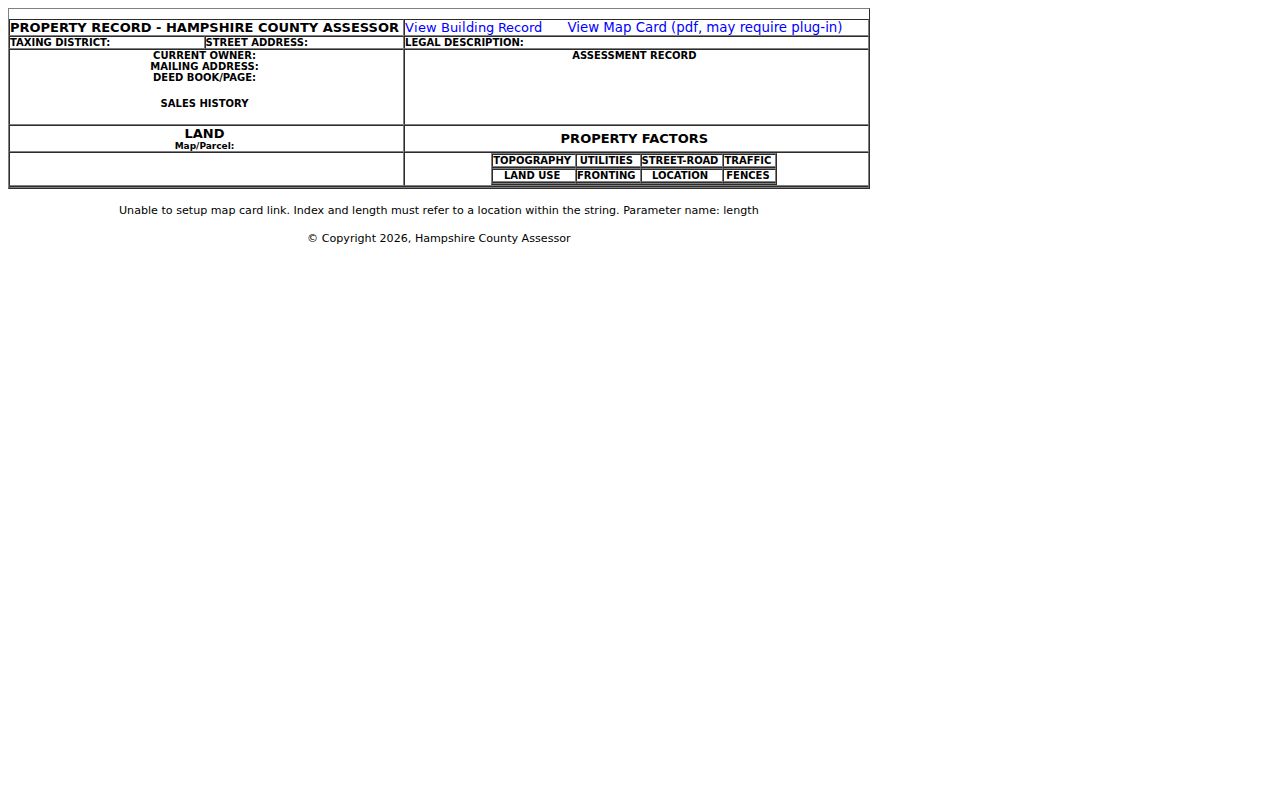
Deed book/page bridges the tax-roll name to the Clerk's instrument.
Hampshire County Ownership Sources
No single Hampshire source answers every ownership question. The Assessor roll is a convenient current pointer. The deed index documents a recorded transfer and related land filings. GIS ties the parcel to a map. The state business database may explain an entity named in a deed, so use these sources together without treating a map label or a company agent as the titled owner.
| Source | Owner Info It Gives | Access |
|---|---|---|
| Assessor card | CURRENT OWNER, mailing, situs, parcel, and deed reference | County card or statewide search |
| County Clerk land index | Recorded grantee and instrument type | Portal landing page, courthouse, or custodian request |
| WV Property Viewer | Surface parcel location and map context | Free state viewer; tax lines only |
| WV SOS Business Search | Entity name, status, and registered-agent clues | Official state entity search |
The state assessment search covers the most ground. It exposes owner, address, parcel, map, and deed-reference fields. The Hampshire County Clerk portal lists land-record categories, but its public landing page does not confirm search fields or image fees.
- Owner of record
- The person or entity named in the assessor or recorded land record.
- Grantee
- The party receiving an interest under a recorded instrument.
- Title
- The legal interest conveyed and recorded; a name match alone is not a title opinion.
- Situs and mailing
- The parcel's physical location and the separate address used for notices.
When a Hampshire Deed Confirms Ownership
A deed connects a grantor to a grantee. In Hampshire, the Assessor card's book/page reference is the bridge. Find the instrument in the Clerk index. Then compare its legal description with the parcel card. Recorded land categories include deeds, deeds of trust, liens, releases, plats, assignments, affidavits, and trustee reports of sale. A later release or assignment can matter even when the current owner name looks clear.
The portal states no online cutoff or image rules. If an instrument will not open, ask the County Clerk about courthouse inspection or a mailed copy, and confirm current costs. Do not assume the owner field alone proves a lien or mortgage discharged. The recorded release, not the tax card, settles that.
Annual Lag in Hampshire Owner Data
The state Viewer updates its assessment data annually. A simple ownership change may not have reached the public map yet. New parcel lines after a transfer can take longer still. The assessor map workflow uses a February 1 submission date for July-to-June transfers. The state suggests contacting the Assessor if new lines stay missing after two years. For a fresh Hampshire sale, the latest recorded deed confirms the grantee. Not every source changes at closing. The tax card catches up later. The GIS line can lag even longer. Compare dates and descriptions. The WV assessment update guidance states these refresh limits. Its image makes the lag visible before you rely on a map label.
Keep the recording date and parcel description close.
Hampshire LLC and Estate Owners
A deed may name an LLC, estate, trustee, executor, or administrator rather than a person. The state business search can confirm an entity's exact legal name, status, organization date, and registered agent. A registered agent just receives notices. That is not land ownership. The recorded deed names the real grantee.
For a deceased owner, the County Clerk holds wills, estate and probate material alongside the land records. Look for an executor or administrator deed, affidavit, deed of distribution, or later conveyance. Historical Hampshire lists wills from 1756 through 1970, with some books missing, plus an index to wills. Probate bonds and settlements survive too. Match each probate clue to the land instrument.
Mailing and Situs in Hampshire
The assessor card keeps MAILING ADDRESS separate from STREET ADDRESS. A mailing field says where tax notices go; it does not show where an owner lives or who occupies the property. Hampshire statements are sent around July 15 using the name and address on the deed as of July 1 of the prior year unless the tax office has another destination. This annual timing can leave a former owner on a recent ticket.
Use the situs, legal description, and parcel ID to identify the land. Treat a ZIP or post-office name as delivery geography rather than a city-limit record. If the mailing name is outdated, compare the deed and ask the Assessor or Treasurer which office can update its own field.
Limits of a Hampshire Owner Lookup
A Hampshire County owner lookup has firm limits. It shows what the public property records identify. It does not show who occupies a parcel. It also does not confirm whether the deed chain is free of claims. An LLC or an estate can hold title as grantee. The Assessor card may lag behind a recent recording. The GIS parcel works as a tax reference rather than title proof or a survey. West Virginia's FOIA opens access, subject to statutory exemptions and protected information.
Lawful use. Keep owner information to property research, title questions, and civic purposes. Do not use public data to stalk, threaten, or harass anyone, and do not treat a name match as proof of residence.