
Hampshire County Deed Record Types
The Clerk's land-record page sorts filings by instrument. A deed records a transfer of ownership. A deed of trust records a security interest. Around them sit releases, assignments, liens, affidavits, plats, and trustee reports. The index landing page confirms these categories but does not publish a full field list or image terms.
| Deed Type | What It Does | Common Use |
|---|---|---|
| Deed | Recorded transfer of a real-property interest | Confirm parties and legal description |
| Deed of trust | Security instrument tied to property | Search later releases or assignments |
| Release | Recorded release or satisfaction entry | Check after a trust or lien |
| Trustee report of sale | Foreclosure-related sale filing | Follow with later deed or order |
| Plat or assignment | Map or transfer of a record interest | Match to the parcel description |
A recorded deed is not the same as a lien or security instrument. Search each category on its own. The Hampshire County land-record portal carries the official category list.
Hampshire County Index Categories
The County Clerk's inventory runs well past deeds. Deeds of trust, judgment liens, child-advocate liens, state and federal liens, releases, church trustees, cemetery deeds, restricted military discharges, trustee reports of sale or foreclosure, plats, assignments, agreements, and affidavits all appear. That is wider than a simple deed search. A transfer may need a later release or a related court filing to make sense.
The portal landing page shows no grantor, grantee, document-type, date, or parcel search controls. It also lists no online start year, image cutoff, copy fee, or result cap. Ask the Clerk directly. Staff can say which fields are searchable. They can also tell you whether an older book or a courthouse terminal holds the rest.
The Hampshire County Clerk's index page displays categories and office information. It does not show a populated deed result.
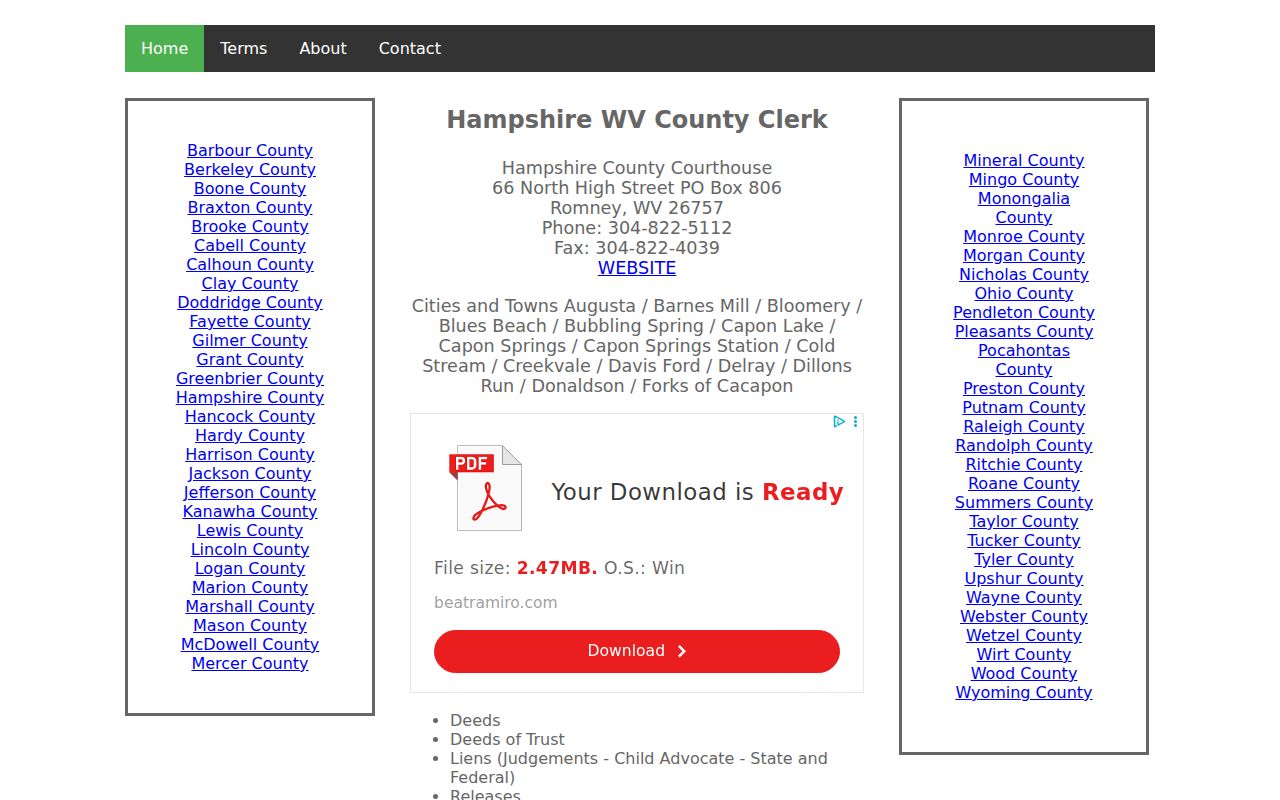
Use these category names as a Hampshire parcel checklist.
Following Hampshire Grantors and Grantees
The grantor conveys the interest; the grantee receives it. Start with the known grantee on the latest deed. Read the grantor name and the legal description. Then search that grantor as a grantee on an earlier transaction. Repeat the process, confirming each instrument describes the same Hampshire County land, and remember this is a record trail rather than a title opinion.
- Use the assessor card's DEED BOOK/PAGE and legal description to identify the current instrument.
- In the Clerk index, find the current grantee and open the corresponding deed.
- Read the grantor and compare the deed's parcel description to the assessment record.
- Search the prior grantor as an earlier grantee, then repeat until the index or source period ends.
- Ask the Clerk or archive about microfilm when online access does not reach the earlier instrument.
- Grantor
- The party conveying an interest in the instrument.
- Grantee
- The party receiving the interest.
- Chain of title
- The ordered sequence of recorded transfers for the same land.
- Book/page
- The assessor card's cross-reference to a deed or filing.
Hampshire Deeds of Trust and Releases
A deed of trust, release, assignment, or lien is not the deed. It does not convey ownership. Hampshire's Clerk index lists deeds of trust, judgment liens, and child-advocate liens. State and federal liens, assignments, and releases appear too. Search by parties and instrument type. An obligation tied to land may hide behind any of them. A release or satisfaction can close one filing. A name-only search may also pull a different borrower or parcel.
Match the legal description, book/page, and parties first. The portal does not publish full search controls or online image charges. If a record stays out of view, ask the County Clerk. A courthouse terminal or copy request may reach it. A title professional can then judge whether the full recorded chain resolves the interest.
Hampshire County's Historic Deed Run
Historical Hampshire's finding aid lists a deed-index microfilm run covering 1756 through 1969. Deed records run from 1757 through 1901. The aid also covers land records from 1809-1826, a survey book from 1783-1861, and Mitchell surveys from 1788-1803. Those dates describe archival material, not the portal's online start year. Use the finding aid to pick a volume or reel.
The local preservation account says bound deed books, wills, and estate settlements left the courthouse during the Civil War while unbound material stayed. Land records survived and came back. Some will books remain missing. That history explains why a Hampshire chain may depend on named volumes and microfilm rather than a continuous web index.
The Historical Hampshire finding aid locates each record range. The Clerk's online land index does not show the microfilm.
Hampshire Court Files and Land Claims
Some title questions outgrow the deed index. Foreclosure, lis pendens, partition, quiet title, mechanic's-lien enforcement, judgments, tax collection, and probate disputes all move into Hampshire Circuit Court. The Circuit Clerk's contact page routes deed, land, wills, and estate matters to the County Clerk. Its form handles inquiries, not filings. The county publishes no public web docket.
The Circuit Clerk sits at 50 South High Street, Suite 157, Romney. Weekday hours run 8:00 to 4:00. Ask whether an in-person terminal shows docket entries, judgments, sale orders, or archived cases. Note the case number and filing date. Then check the County Clerk for any deed, lien, or release that followed.
The Hampshire Circuit Clerk contact page marks the office route for anything that may involve a court file.
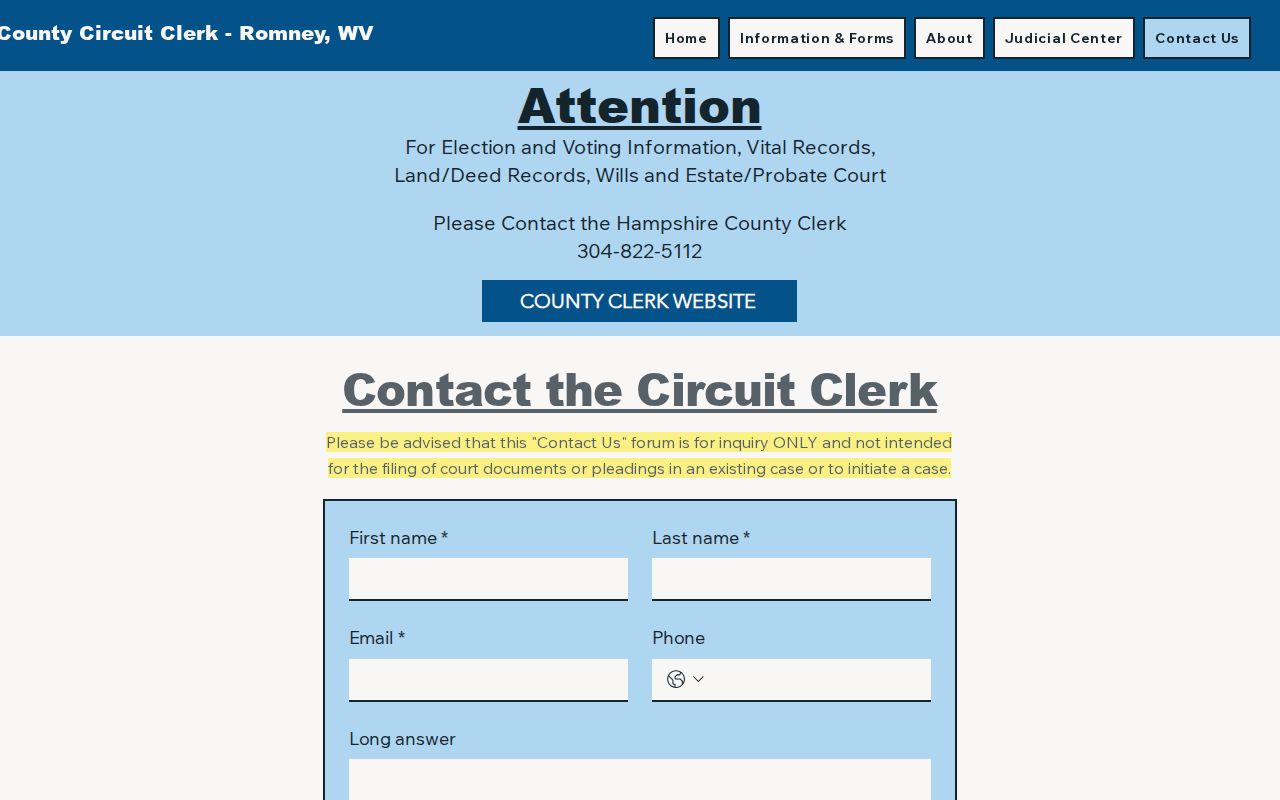
Use that office for court-file routing. The contact page is not a deed-search result. The West Virginia courts gateway anchors statewide court information, though no Hampshire County docket search sits there.
Start with the state gateway for general court routes. Then confirm any case through the Circuit Clerk, and track any resulting land instrument through the County Clerk.
Requesting a Hampshire County Deed
The County Clerk portal is the best starting point for a Hampshire County deed search. Not every book is online, though. Some images carry fees, and older deed books may sit only on paper or microfilm. If the record is not online, contact the Hampshire County Clerk at 66 North High Street, PO Box 806, Romney, WV 26757, or call 304-822-5112. Ask about inspection, plain-copy and certified-copy fees, image access, and whether an in-person terminal reaches older books.
For records beyond the portal, the finding aid points to historic microfilm and deed books. A written West Virginia Freedom of Information Act request should name the custodian, the parcel, the instrument type, and the date range. Copy fees and image rules vary. Confirm cost and delivery with the Clerk before sending payment.
Recorded, not guaranteed. Hampshire County deed records show filed instruments, not every unrecorded interest or a complete title opinion. Confirm the source with the Clerk and use a title professional when clear ownership must be established.